

Xenii
.
- Joined
- Feb 16, 2024
- Messages
- 125
- Likes
- 446
- Location
- Switzerland
- Portables
- Xii-Boy Original, Xii-Boy Pocket, Xii-Boy Ultra
Hey there!
I've always wanted to start this worklog, but I actually never taken the time.
I feel like it's the right moment to fix that
Welcome to the first episode of Matterhorn 64's worklog!
This worklog is going to be pretty different than what I was used to do so far.
It is going to be more accessible, with a lot of explanation
My goal with this worklog is to share my passion about the Nintendo 64 and electronical engineering.
I truly wish this will give motivation and inspiration to anyone who ever dreamed of doing something similar.
Alright, let's get started
Preface:
Right after finishing the Xii-Boy Ultra, about a year ago, I decided to think of a new and innovative project.
Of course, I've been working on the Xii-Boy Ultra Beta Kits.
As I made research about all the administrative work for that project, I had a crazy idea: Creating a new kind of Nintendo 64 portable.
I've always been blown away by the "3x3" Nintendo 64 motherboard redesign. @marshallh, @Gman, @thedrew and @SparkleBear have all been a huge source of inspiration.
However, I was kinda sad of not having a sight of any accessible or open sourced Nintendo 64 portable which would use these redesigned motherboard.
Therefore, I decided to make my own!
I shared a lot of thoughts and ideas with @CrazyGadget. With his advice, I was able to start what's going to be released as Matterhorn 64.
You might be familiar with the name Matterhorn. It is probably the most iconic and famous mountain of Switzerland, and maybe the most famous of the world.
I wanted to make a project which was more personal than the previous ones, therefore, I wanted to find a name which reminds of my country; Switzerland.
Furthermore, I also wanted a name which was as high as my ambitions. Matterhorn just came to my mind.

Seriously, what on earth is more majestic than this?
The following months have been busy with the Xii-Boy Ultra Beta Kits. I took a lot of time correcting all its issues, and finally making a big order back in October of 2025.
And then, I had a lot of free time just waiting for packages to come. Since I had 2 weeks of school holidays, I decided to spend my time learning
about the Nintendo 64 in order to finally start the Matterhorn project.
First things first, what is Matterhorn 64, and what are my ambitions with it?
Since my entry in this community 2 years ago, I've been focusing on the Nintendo Wii.
The Wii is an awesome console to get started with modding. I've always had a lot of fun designing consoles like the Xii-Boy Ultra.
However, I've always considered the Nintendo 64 was an underrated console, and that the system deserved more love
Of course, a lot of incredible mods have been released on that system, but I always wanted to do my own.
Matterhorn 64 is going to be my attempt to create the ultimate Nintendo 64 portable.
What should we expect from Matterhorn 64?
My key word for this project is innovation. I want Matterhorn 64 to be a new generation of Nintendo 64 portable.
First of all, Matterhorn 64 will follow all my standards;
Matterhorn 64 will be designed with a horizontal layout. My Xii-Boys are all vertical layout. I like it, but I wanted to try something different for this new console. Unlike most of the Nintendo 64 portables, Matterhorn will not rely on cartridges. Instead, an integrated Summer Cart 64 will handle the games.
I know this choice is kinda controversial, so lemme explain my thoughts here:
On the Wii modding scene, the DVD drive has been removed. It was big, inconvenient, sucked a lot of power and was noisy.
Nobody uses disk drives on our portable anymore. So why would we keep the old gigantic cartridges on our Nintendo 64 portables?
Yes, cartridges don't suck as much power as a disk drive, yes they are completely quiet, but they're huge!
Keeping the cartridge would just make a ultra thick portable. My goal with Matterhorn 64 is to make a console as thick as 2cm. That's pretty much the thickness of the cartridge itself.
I heard a lot of people being kinda sad about my idea, and I thought about it. Matterhorn 64 will be able to play full size cartridges.
In order to do that, the console will have an expansion port on the back made of magnets and pogo pins. Through this port, we will be able to plug many different modules.
The most important will be the dock; Matterhorn 64 will be compatible with an awesome dock. It will have its own cartridge port, controller port, and all the other things needed for a dock.
We will also be able to plug a charging stand! An adapter to plug full size cartridges and maybe a feature to connect multiple Matterhorn 64 consoles together in order to play multiplayer mode!
Having an expansion slot on the back of Matterhorn fixes all of the cartridge size issues, while keeping the ability to play them if wanted. It will bring a lot modularity into the console while keeping it identical. You will just be able to swap and insert the modules you want in order to play the way you want.
All of this, with a single consoles, no different versions all over the places.
Furthermore, having an integrated flashcart will allow us to customize the user interface of the console! We could imagine an awesome Matterhorn theme, and so much more.
An issue I find with the Xii-Boy Ultra is the number of required PCB. The console requires 7 custom PCBs + the ones from 4Layer Tech.
I'd like to create a single motherboard for Matterhorn 64. Having a single board reduces a lot the production price. It also makes PCBA easier and cheaper.
Finally, it will also look way more professional, and will be much easier to take apart if needed. Overall, having a recreated motherboard will allow us to avoid trimming, which is an easy process for many, but personally one I dislike.
The console will be able to be undervolted. Two flat lipo batteries will be used to have 10Ah of battery capacity.
It will also integrate a microcontroller like an ESP32 to use wireless controllers, or to handle some extra features.
The cooling system will rely on either a Switch fan or anything thinner. I really want to have a thin portable for this console.
Actually, my goal is not to make the smallest Nintendo 64 portable, but the best one out there.
Most importantly, the console will have its own Diplay Direct Driver. No HDMi or VGA.
Fair warning though, Matterhorn 64 will not be a simple build.
I will pack all my ideas and often ask people opinion for each thing that I can't decide on my own.
I will also try my best to optimize the design. My goal is also to make the console relatively cheap.
To sum up:
What I've done so far:
In order to create this unique all-in-one Matterhorn 64 motherboard, I would first need to reverse engineering the original Nintendo 64 motherboard.
This process is extremely complicated, and is without a doubt the most complicated step of the whole project.
As I just mentioned, there are four people who officially gave it a shot and shared their progress over the Bitbuilt community. Only 2 succeed.
Making my own was extremely complicated because it requires a lot of knowledge.
Since I didn't know a thing about the Nintendo 64, I had to make a lot of research online about how the system worked.
I had to understand in depth the role of each component of the console, and understand how they all communicate in order to operate properly.
Normally, I would have need to probe manually the whole console with my multimeter in order to know where each trace goes and what signal travels through it.
Hopefully though, I was able to find some decent schematic and documentation online which helped a lot with that process.
However, since none of the working motherboard recreation were open sourced at the time, I had to manually understand what component was needed for the motherboard redesign and what component was not in order to make it as small as possible.
This took a lot of time, but with the huge help of @YveltalGriffin , I was able to figure it out.
I called the Matterhorn 64 CORE the boards which contains all the necessary components for the system in order to boot and work as intended while keeping it compatible with the whole library of games and by keeping it as small as possible.
When I understood what components were needed, I started designing the board back in October 2025. I first designed the symbol of the Nintendo components on KiCad.
I then imported them in my schematic and made all the connections between these components.
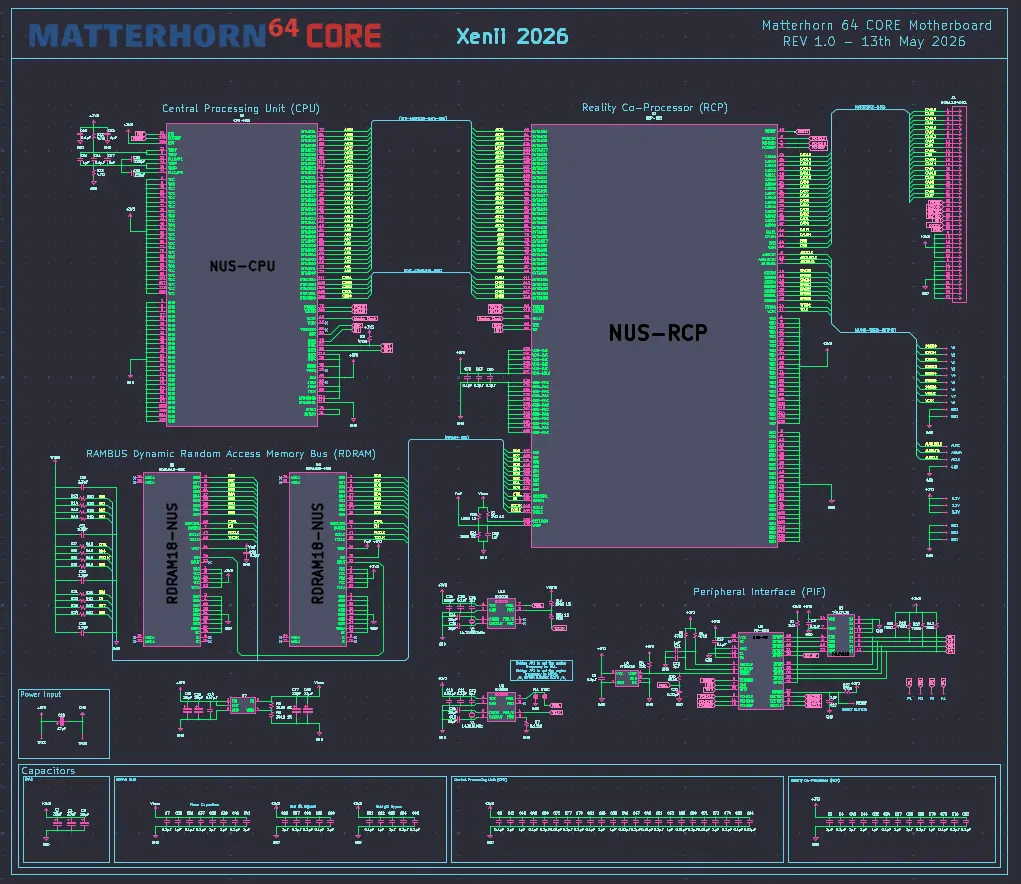
I then designed the footprint with the contribution of @cy. After a few weeks, the board was designed!
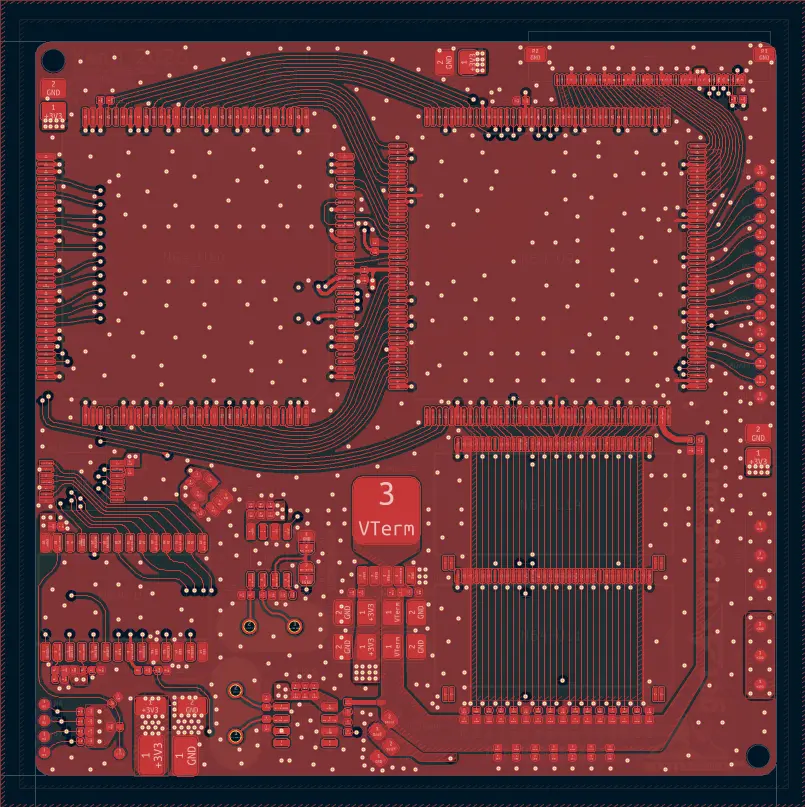
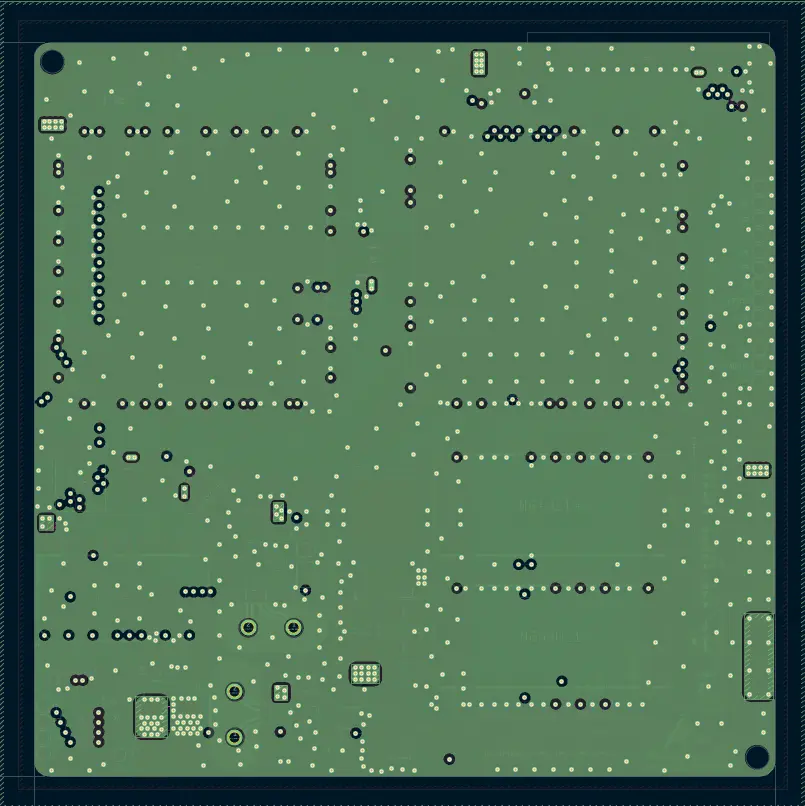
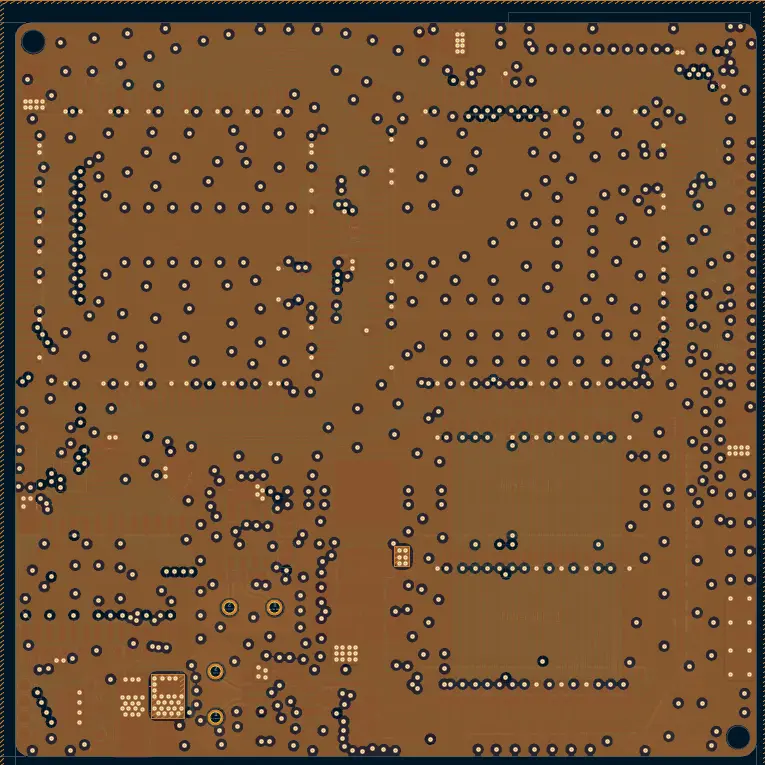
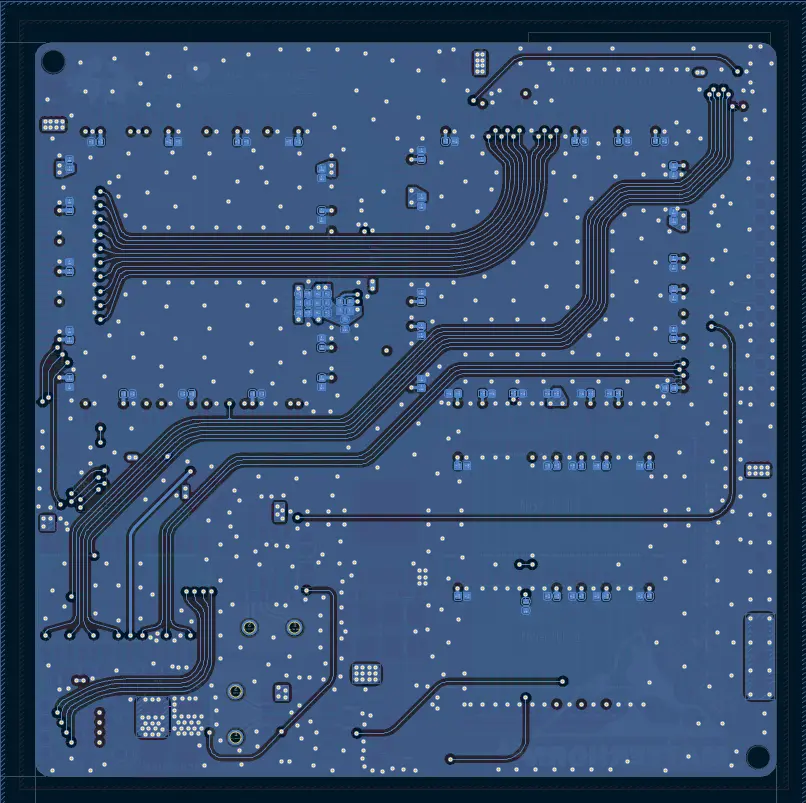
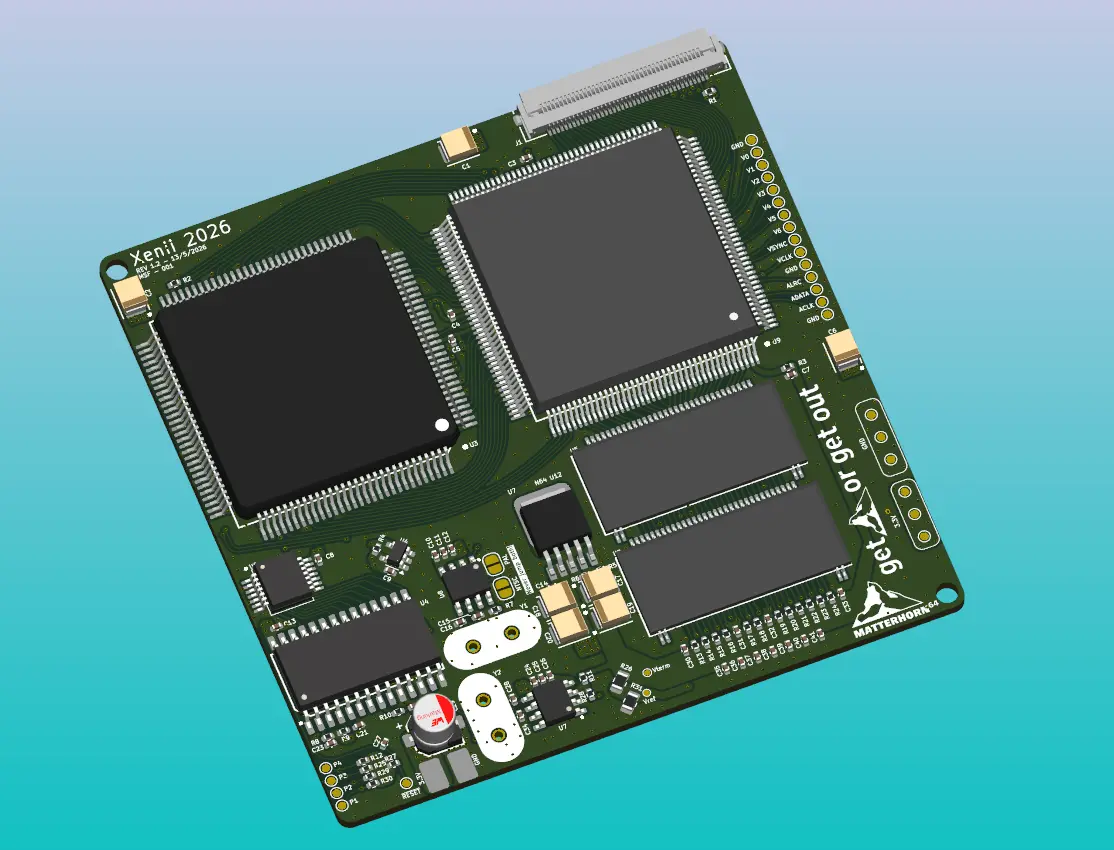
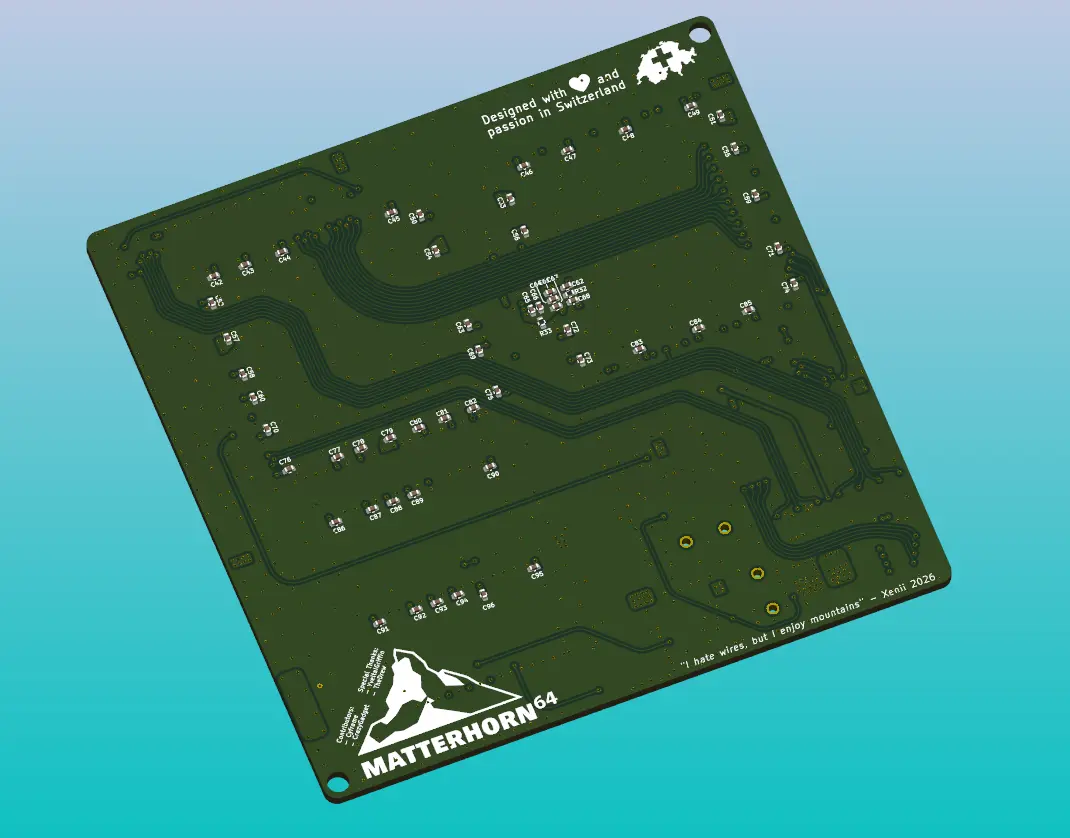
Yveltalgriffing gave me the advice of routing the board with the any angle mode. Basically, instead of drawing the traces with 45° angles, I would be able to route them with the angle I wanted. I also decided to route everything with rounded corners in order to make really pretty board.
The trickiest part of the system is for sure the RDRAM Bus.
But what's so special about the RDRAM Bus?
First, we need to know the RAM stands for Random Access Memory. It's a volatile memory which is used to store all the temporary data at a high speed.
On the Nintendo 64, Nintendo collaborated with RAMBUS. A company specialised into RAM chips.
RAMBUS developed the RDRAM technology back in the early 90s.
the RDRAM stands for RAMBUS Dynamic Random Access Memory. Unlike regular RAM chips which rely on transistor circuits to maintain a certain logic level, Dynamic RAM relies on capacitors in order to store the data.
If the capacitor is charged, its stored value is 1, otherwise, if it's empty, it's worth 0.
Dynamic RAM is great because it is more compact and cheaper to build.
However, the DRAM uses a lot of power. Since everything is stored on small batteries (capacitors), charging them takes a lot of energy.
Furthermore, like all the capacitors, they are not perfect. Meaning they will slowly discharge after a while, which can cause data loss.
To correct that, the Nintendo 64 has to refresh and recharge all the capacitors in order to keep storing the data.
Also, every single time we read the content of the DRAM, the capacitors all discharge, meaning the system has to recharge them after each read.
Finally, unlike most RAM chips which had one address bus (used to select the cell we want to use), one data bus (used transfer the data) and one command bus (used to say if we either want to write or read the cell), the RDRAM only has two. Both address bus and data bus have been combined, and the command bus is used to tell if what on the bus is either the address or the data.
All of this makes the RDRAM bus to be extremely fast. On the Nintendo 64, the RDRAM operates at 250MHz. This means the signal "repeats itself" 250 million times per second.
Considering a signal changes its logic level 2 times per period, each of the 9 RDRAM bus traces change their logic level 500 million times per second.
Therefore, the RDRAM bus needs to be routed perfectly in order to make the system boot.
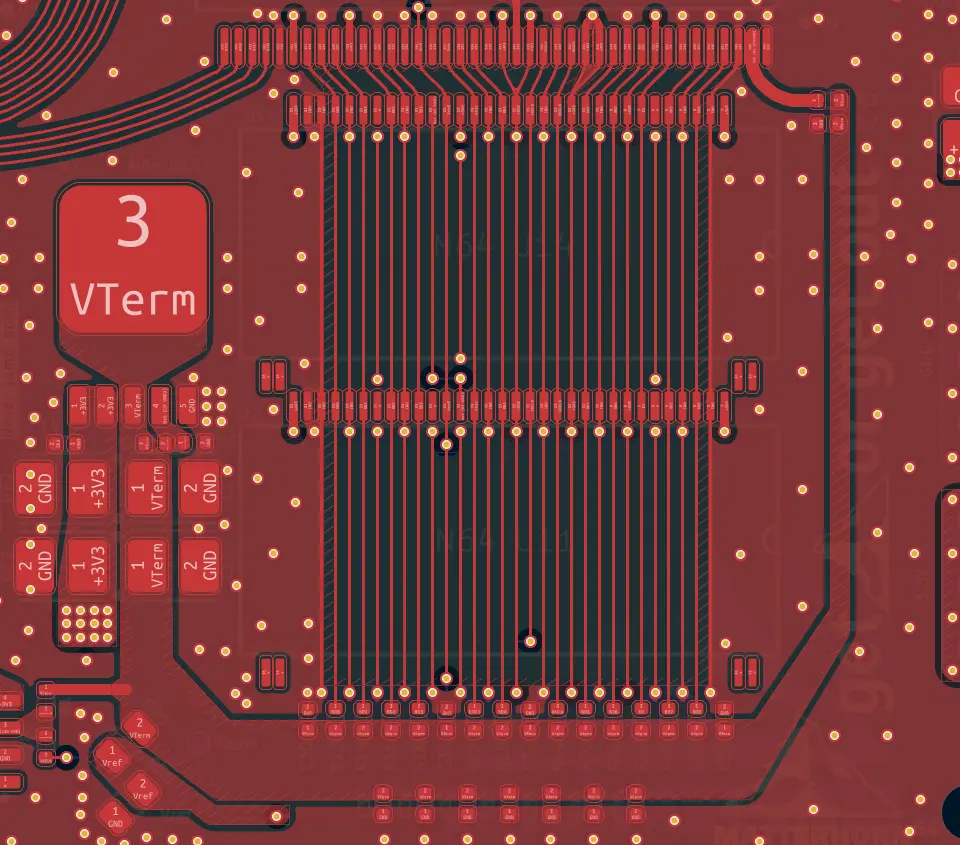
I calculated the impedance of the traces to be 50Ω. The boards contains 4 layers, which definitively makes this easier.
After 5 months shared with both Xii-Boy Ultra Kits and Matterhorn 64 CORE redesign, I was able to order it.
A week later, something came into the mailbox!
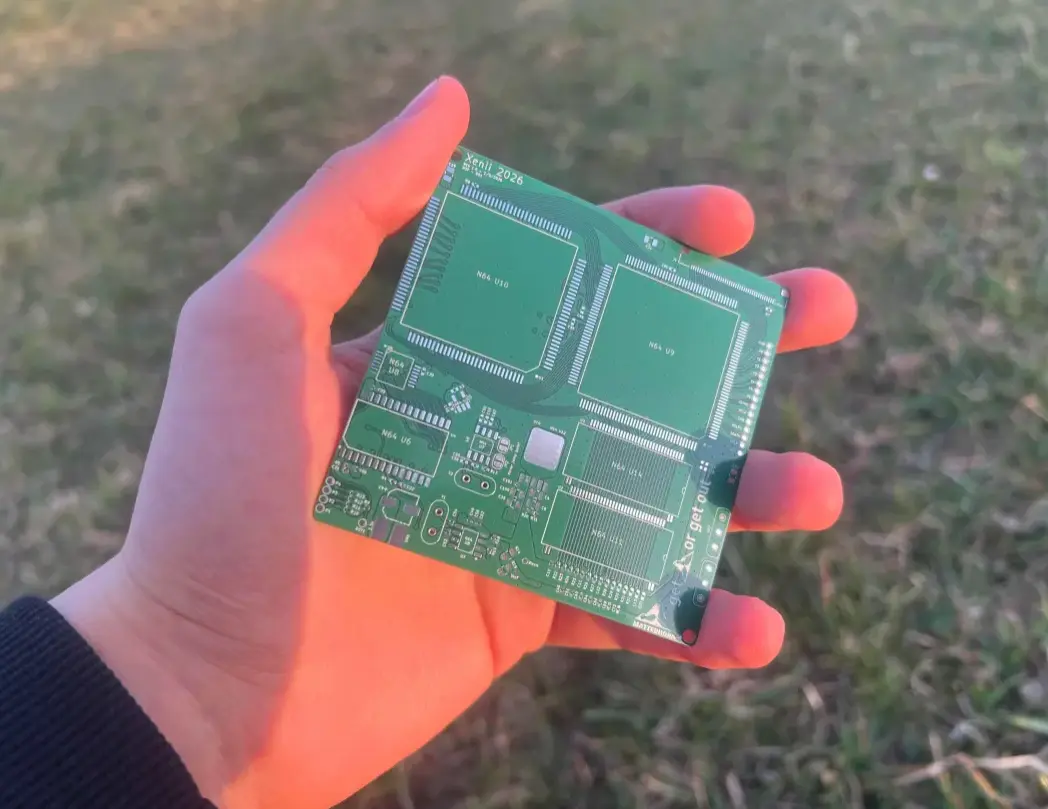
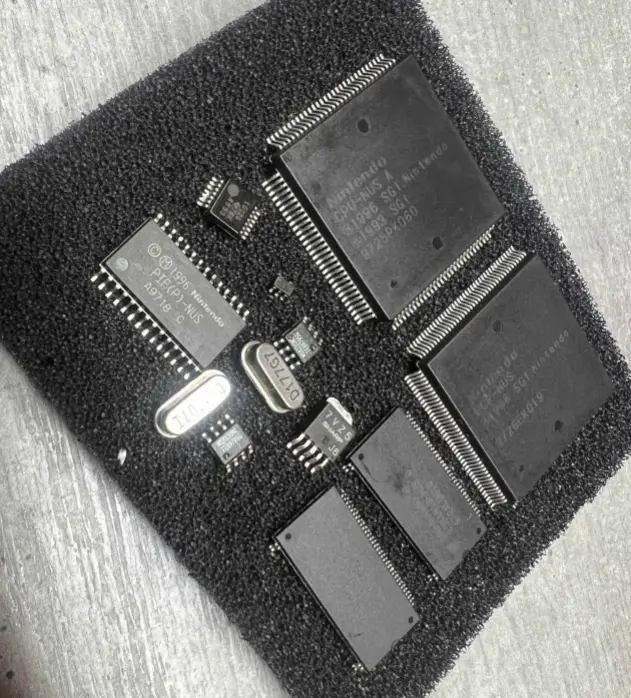
I then desoldered the components from the donor board:
And here is the final result!
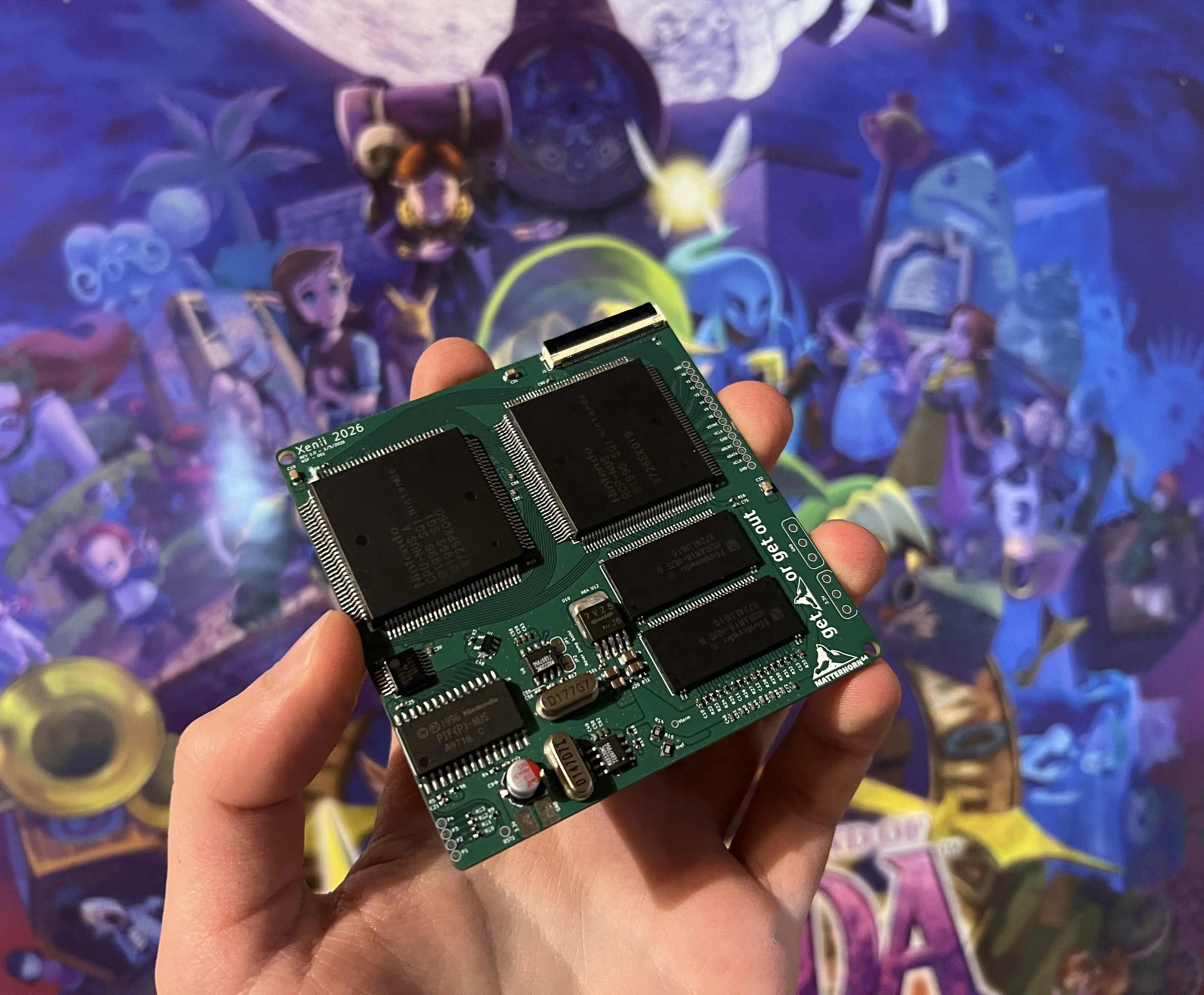
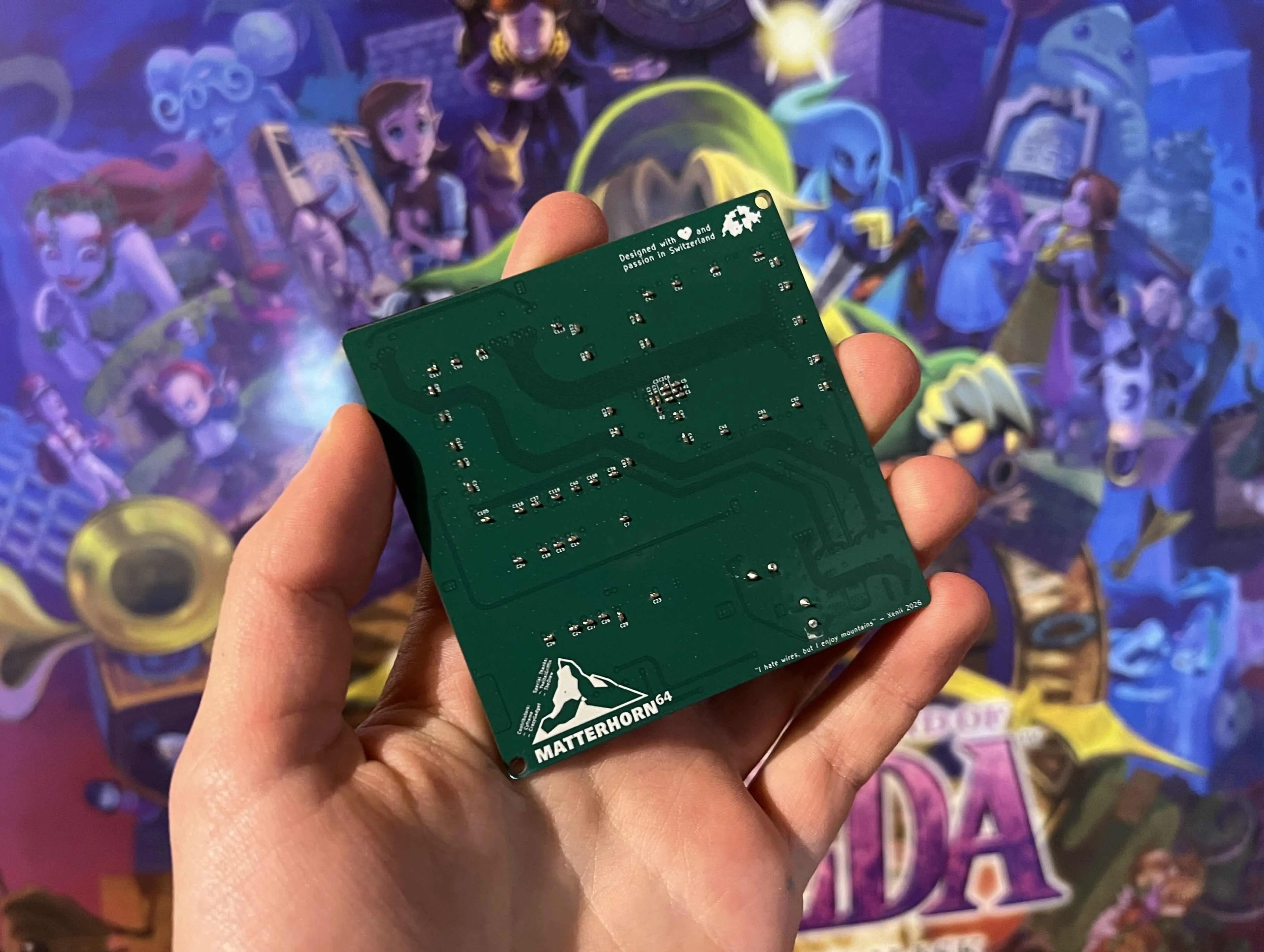
After a few weeks of troubleshooting, I was able to confirm the board was working!!
The board had one major issue though: It only work if either undervolted or heated.
I did a lot of tests and was unable to find what was wrong. I compared most of my measurements with an original console and wasn't able to find any difference.
I assume I damaged one of the components when desoldering it. I also regret having used some low melting temperature solder, which add a level or reliability issues.
Anyway, here is a little video of the CORE running!
I actually released the board on GitHub for anyone who wanted to build their own: Matterhorn 64 CORE Github
With that success I'll be able to continue my journey and design the rest of the console
So what's next?
The following month will actually be dedicated to two different projects:
Weisshorn 64 is going to an Nintendo 64 Classic Mini console. It will deserve its own worklog, but it's the project I'm currently working on.
I know it might sound weird to make a worklog about a project I'm not working on yet, but I really wanted to share all of what I've done here.
I guess that's all for that first episode. I hope you enjoyed reading my plans for this new Nintendo 64 portable.
I appologize for the quality of that episode, I'm quite in a rush. I really wanted to share all of this tonight. I hope you like that episode and that you're hyped by this new project!
Special thanks:
PS: Matterhorn 64 will not have a handle. Please don't judge me @Redherring32 ):
I've always wanted to start this worklog, but I actually never taken the time.
I feel like it's the right moment to fix that
Welcome to the first episode of Matterhorn 64's worklog!
This worklog is going to be pretty different than what I was used to do so far.
It is going to be more accessible, with a lot of explanation
My goal with this worklog is to share my passion about the Nintendo 64 and electronical engineering.
I truly wish this will give motivation and inspiration to anyone who ever dreamed of doing something similar.
Alright, let's get started
Preface:
Right after finishing the Xii-Boy Ultra, about a year ago, I decided to think of a new and innovative project.
Of course, I've been working on the Xii-Boy Ultra Beta Kits.
As I made research about all the administrative work for that project, I had a crazy idea: Creating a new kind of Nintendo 64 portable.
I've always been blown away by the "3x3" Nintendo 64 motherboard redesign. @marshallh, @Gman, @thedrew and @SparkleBear have all been a huge source of inspiration.
However, I was kinda sad of not having a sight of any accessible or open sourced Nintendo 64 portable which would use these redesigned motherboard.
Therefore, I decided to make my own!
I shared a lot of thoughts and ideas with @CrazyGadget. With his advice, I was able to start what's going to be released as Matterhorn 64.
You might be familiar with the name Matterhorn. It is probably the most iconic and famous mountain of Switzerland, and maybe the most famous of the world.
I wanted to make a project which was more personal than the previous ones, therefore, I wanted to find a name which reminds of my country; Switzerland.
Furthermore, I also wanted a name which was as high as my ambitions. Matterhorn just came to my mind.
Seriously, what on earth is more majestic than this?
The following months have been busy with the Xii-Boy Ultra Beta Kits. I took a lot of time correcting all its issues, and finally making a big order back in October of 2025.
And then, I had a lot of free time just waiting for packages to come. Since I had 2 weeks of school holidays, I decided to spend my time learning
about the Nintendo 64 in order to finally start the Matterhorn project.
First things first, what is Matterhorn 64, and what are my ambitions with it?
Since my entry in this community 2 years ago, I've been focusing on the Nintendo Wii.
The Wii is an awesome console to get started with modding. I've always had a lot of fun designing consoles like the Xii-Boy Ultra.
However, I've always considered the Nintendo 64 was an underrated console, and that the system deserved more love
Of course, a lot of incredible mods have been released on that system, but I always wanted to do my own.
Matterhorn 64 is going to be my attempt to create the ultimate Nintendo 64 portable.
What should we expect from Matterhorn 64?
My key word for this project is innovation. I want Matterhorn 64 to be a new generation of Nintendo 64 portable.
First of all, Matterhorn 64 will follow all my standards;
- It is going to be 100% open-source
- Will be released under the CERN-OHL-S-2.0 license
- Will be 100% wirefree, and maybe be the world's first wirefree Nintendo 64 portable
Matterhorn 64 will be designed with a horizontal layout. My Xii-Boys are all vertical layout. I like it, but I wanted to try something different for this new console. Unlike most of the Nintendo 64 portables, Matterhorn will not rely on cartridges. Instead, an integrated Summer Cart 64 will handle the games.
I know this choice is kinda controversial, so lemme explain my thoughts here:
On the Wii modding scene, the DVD drive has been removed. It was big, inconvenient, sucked a lot of power and was noisy.
Nobody uses disk drives on our portable anymore. So why would we keep the old gigantic cartridges on our Nintendo 64 portables?
Yes, cartridges don't suck as much power as a disk drive, yes they are completely quiet, but they're huge!
Keeping the cartridge would just make a ultra thick portable. My goal with Matterhorn 64 is to make a console as thick as 2cm. That's pretty much the thickness of the cartridge itself.
I heard a lot of people being kinda sad about my idea, and I thought about it. Matterhorn 64 will be able to play full size cartridges.
In order to do that, the console will have an expansion port on the back made of magnets and pogo pins. Through this port, we will be able to plug many different modules.
The most important will be the dock; Matterhorn 64 will be compatible with an awesome dock. It will have its own cartridge port, controller port, and all the other things needed for a dock.
We will also be able to plug a charging stand! An adapter to plug full size cartridges and maybe a feature to connect multiple Matterhorn 64 consoles together in order to play multiplayer mode!
Having an expansion slot on the back of Matterhorn fixes all of the cartridge size issues, while keeping the ability to play them if wanted. It will bring a lot modularity into the console while keeping it identical. You will just be able to swap and insert the modules you want in order to play the way you want.
All of this, with a single consoles, no different versions all over the places.
Furthermore, having an integrated flashcart will allow us to customize the user interface of the console! We could imagine an awesome Matterhorn theme, and so much more.
An issue I find with the Xii-Boy Ultra is the number of required PCB. The console requires 7 custom PCBs + the ones from 4Layer Tech.
I'd like to create a single motherboard for Matterhorn 64. Having a single board reduces a lot the production price. It also makes PCBA easier and cheaper.
Finally, it will also look way more professional, and will be much easier to take apart if needed. Overall, having a recreated motherboard will allow us to avoid trimming, which is an easy process for many, but personally one I dislike.
The console will be able to be undervolted. Two flat lipo batteries will be used to have 10Ah of battery capacity.
It will also integrate a microcontroller like an ESP32 to use wireless controllers, or to handle some extra features.
The cooling system will rely on either a Switch fan or anything thinner. I really want to have a thin portable for this console.
Actually, my goal is not to make the smallest Nintendo 64 portable, but the best one out there.
Most importantly, the console will have its own Diplay Direct Driver. No HDMi or VGA.
Fair warning though, Matterhorn 64 will not be a simple build.
I will pack all my ideas and often ask people opinion for each thing that I can't decide on my own.
I will also try my best to optimize the design. My goal is also to make the console relatively cheap.
To sum up:
- Matterhorn 64 is my entry into Nintendo 64 modding
- It is going to be an ultimate and awesome Nintendo 64 portable
- It will be 100% open source
- Probably the thinnest Nintendo 64 portable
- 10Ah of battery capacity
- Integrated flashcart
- EXP slot, dock and accessories
- Switch fan
- A single board
- 100% wirefree
- ESP32 for additional features
- Nintendo 64 Direct Display Driver
What I've done so far:
In order to create this unique all-in-one Matterhorn 64 motherboard, I would first need to reverse engineering the original Nintendo 64 motherboard.
This process is extremely complicated, and is without a doubt the most complicated step of the whole project.
As I just mentioned, there are four people who officially gave it a shot and shared their progress over the Bitbuilt community. Only 2 succeed.
Making my own was extremely complicated because it requires a lot of knowledge.
Since I didn't know a thing about the Nintendo 64, I had to make a lot of research online about how the system worked.
I had to understand in depth the role of each component of the console, and understand how they all communicate in order to operate properly.
Normally, I would have need to probe manually the whole console with my multimeter in order to know where each trace goes and what signal travels through it.
Hopefully though, I was able to find some decent schematic and documentation online which helped a lot with that process.
However, since none of the working motherboard recreation were open sourced at the time, I had to manually understand what component was needed for the motherboard redesign and what component was not in order to make it as small as possible.
This took a lot of time, but with the huge help of @YveltalGriffin , I was able to figure it out.
I called the Matterhorn 64 CORE the boards which contains all the necessary components for the system in order to boot and work as intended while keeping it compatible with the whole library of games and by keeping it as small as possible.
When I understood what components were needed, I started designing the board back in October 2025. I first designed the symbol of the Nintendo components on KiCad.
I then imported them in my schematic and made all the connections between these components.
I then designed the footprint with the contribution of @cy. After a few weeks, the board was designed!
Yveltalgriffing gave me the advice of routing the board with the any angle mode. Basically, instead of drawing the traces with 45° angles, I would be able to route them with the angle I wanted. I also decided to route everything with rounded corners in order to make really pretty board.
The trickiest part of the system is for sure the RDRAM Bus.
But what's so special about the RDRAM Bus?
First, we need to know the RAM stands for Random Access Memory. It's a volatile memory which is used to store all the temporary data at a high speed.
On the Nintendo 64, Nintendo collaborated with RAMBUS. A company specialised into RAM chips.
RAMBUS developed the RDRAM technology back in the early 90s.
the RDRAM stands for RAMBUS Dynamic Random Access Memory. Unlike regular RAM chips which rely on transistor circuits to maintain a certain logic level, Dynamic RAM relies on capacitors in order to store the data.
If the capacitor is charged, its stored value is 1, otherwise, if it's empty, it's worth 0.
Dynamic RAM is great because it is more compact and cheaper to build.
However, the DRAM uses a lot of power. Since everything is stored on small batteries (capacitors), charging them takes a lot of energy.
Furthermore, like all the capacitors, they are not perfect. Meaning they will slowly discharge after a while, which can cause data loss.
To correct that, the Nintendo 64 has to refresh and recharge all the capacitors in order to keep storing the data.
Also, every single time we read the content of the DRAM, the capacitors all discharge, meaning the system has to recharge them after each read.
Finally, unlike most RAM chips which had one address bus (used to select the cell we want to use), one data bus (used transfer the data) and one command bus (used to say if we either want to write or read the cell), the RDRAM only has two. Both address bus and data bus have been combined, and the command bus is used to tell if what on the bus is either the address or the data.
All of this makes the RDRAM bus to be extremely fast. On the Nintendo 64, the RDRAM operates at 250MHz. This means the signal "repeats itself" 250 million times per second.
Considering a signal changes its logic level 2 times per period, each of the 9 RDRAM bus traces change their logic level 500 million times per second.
Therefore, the RDRAM bus needs to be routed perfectly in order to make the system boot.
I calculated the impedance of the traces to be 50Ω. The boards contains 4 layers, which definitively makes this easier.
After 5 months shared with both Xii-Boy Ultra Kits and Matterhorn 64 CORE redesign, I was able to order it.
A week later, something came into the mailbox!
I then desoldered the components from the donor board:
And here is the final result!
After a few weeks of troubleshooting, I was able to confirm the board was working!!
The board had one major issue though: It only work if either undervolted or heated.
I did a lot of tests and was unable to find what was wrong. I compared most of my measurements with an original console and wasn't able to find any difference.
I assume I damaged one of the components when desoldering it. I also regret having used some low melting temperature solder, which add a level or reliability issues.
Anyway, here is a little video of the CORE running!
I actually released the board on GitHub for anyone who wanted to build their own: Matterhorn 64 CORE Github
With that success I'll be able to continue my journey and design the rest of the console
So what's next?
The following month will actually be dedicated to two different projects:
- Matterhorn 64
- Weisshorn 64
Weisshorn 64 is going to an Nintendo 64 Classic Mini console. It will deserve its own worklog, but it's the project I'm currently working on.
I know it might sound weird to make a worklog about a project I'm not working on yet, but I really wanted to share all of what I've done here.
I guess that's all for that first episode. I hope you enjoyed reading my plans for this new Nintendo 64 portable.
I appologize for the quality of that episode, I'm quite in a rush. I really wanted to share all of this tonight. I hope you like that episode and that you're hyped by this new project!
Special thanks:
- @YveltalGriffin for his help, routing advice and general answers to my questions
- @marshallh, @Gman, @thedrew and @SparkleBear for their huge inspiration and their help
- @CrazyGadget for his advice and ideas
- @cy for his contribution to some of the footprint
PS: Matterhorn 64 will not have a handle. Please don't judge me @Redherring32 ):
Last edited: