
Worklog Bwiizness: RVK-01 PCB Reverse Engineer

Joined
Dec 5, 2025
Messages
5
Likes
11
What is it?
I am working on a partial PCB reverse engineer of the RVK-01 Wii PCB, with the end goal of creating a very tiny and capable portable. I call it Bwiizness, since eventually I want to make a board (or stack of boards) about the size of a business card that is a fully capable Wii portable. My work is built on the shoulders of the giants who made the RVK-01 compendium, as well as many other very talented and capable members of the BitBuilt forums.

What's the Scope?
For the first pass of this project, I want to make a 4 layer board that can support all the Wii silicon that is hard or impossible to source off the shelf. This includes the Broadway, Hollywood, NAND flash, GDDR3 RAM, MX, AVE, reset supervisors, and connectors for the WiFi and Bluetooth modules. I plan on redesigning the power supply circuitry using a TPS54331 for each rail. I'll pre-emptively make this as compact as possible.

For the second pass, I want to shrink the design and make it portable-friendly. Add a battery charger, a single programmable PMIC with more voltage rails that can do undervolting, an easier to work with video signal (RGB888, MIPI-DSI, etc), and a microcontroller to replace the U9 and U10 reset supervisors.

For the third pass, I want to try and completely replace the MX chip and emulate it with something like an RP2350. The interface between the MX and the Hollywood seems pretty simple, just a SPI connection and some GPIOs. The protocol appears to be pretty well understood too. It would be really cool if I could soup up the Wii with a really capable system monitor. Something capable of monitoring power consumption, handling power states, emulating controllers, and controllable via software on the Wii itself.

What's Been Done?
  • Traced connections between the Hollywood and Broadway on the RVK-01 Compendium
  • Traced connections between the Hollywood and GDDR3 on the RVK-01 Compendium
  • Traced connections between the Hollywood and NAND Flash on the RVK-01 Compendium
  • Filled out the traces for the MX on the RVK-01 Compendium
  • Desoldered, checked, catalogued resistor and capacitor values for a couple hundred components. This was already done by someone else, but I wanted to double check the measurements just in case.
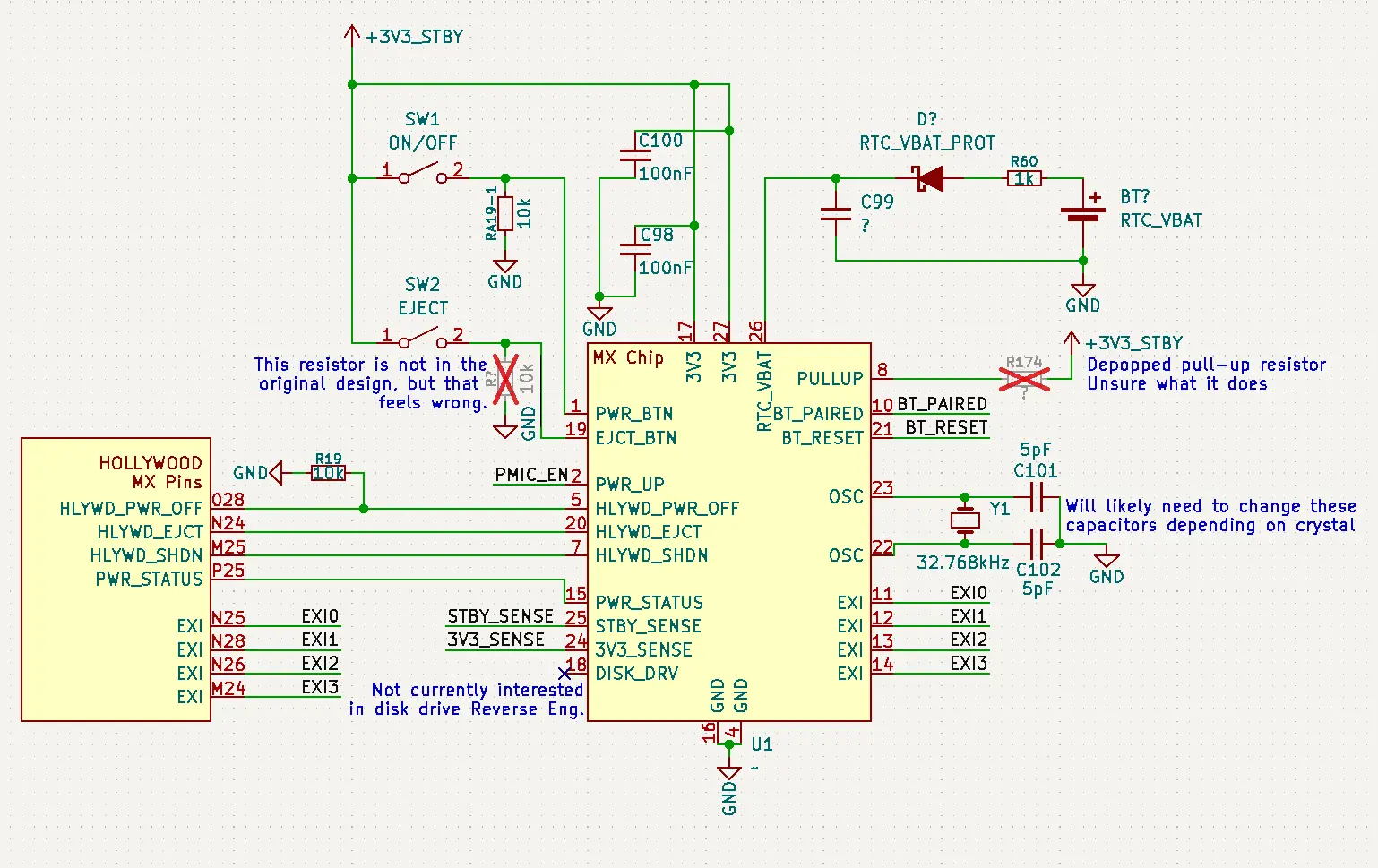
  • Created a schematic for the MX and supporting components
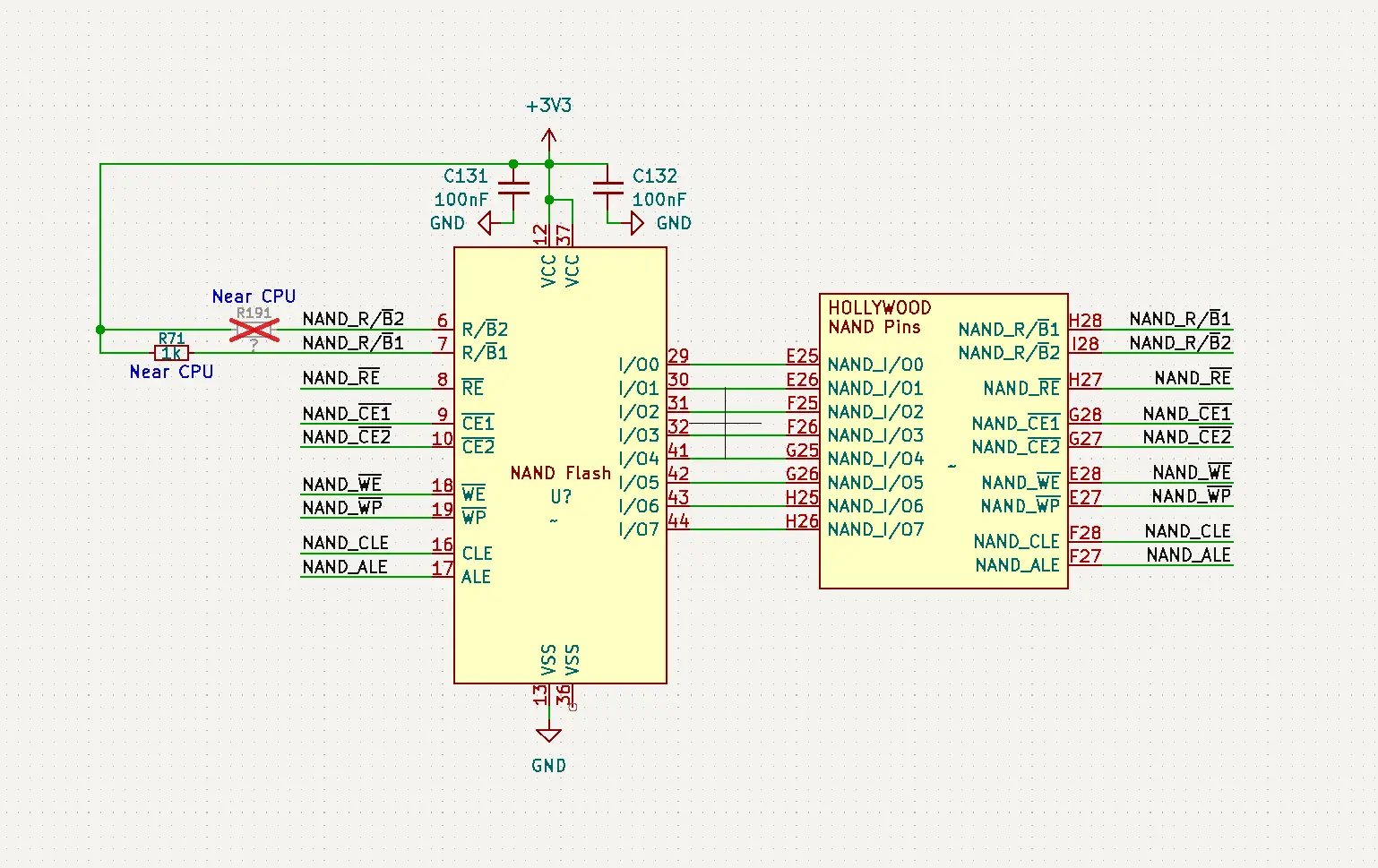
  • Created a schematic for the NAND flash and supporting components
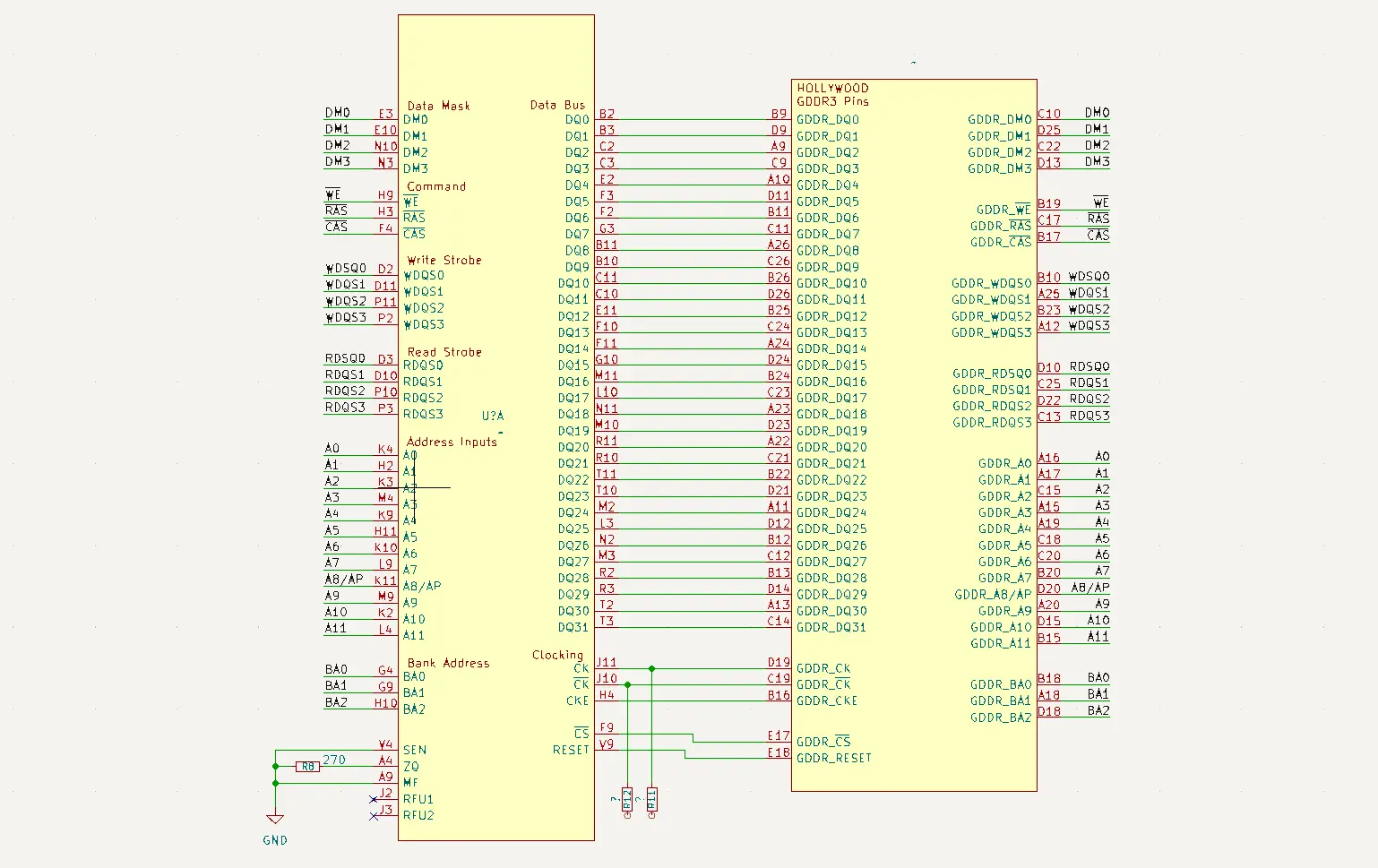
  • Created a schematic for the high speed connections between the Hollywood and GDDR3, no supporting components
  • Created a partial schematic for the GDDR3 power rails and various supporting components. This is what I am currently working on
Why?
There is a worm in my brain telling me to reverse engineer things.

Progress Pictures
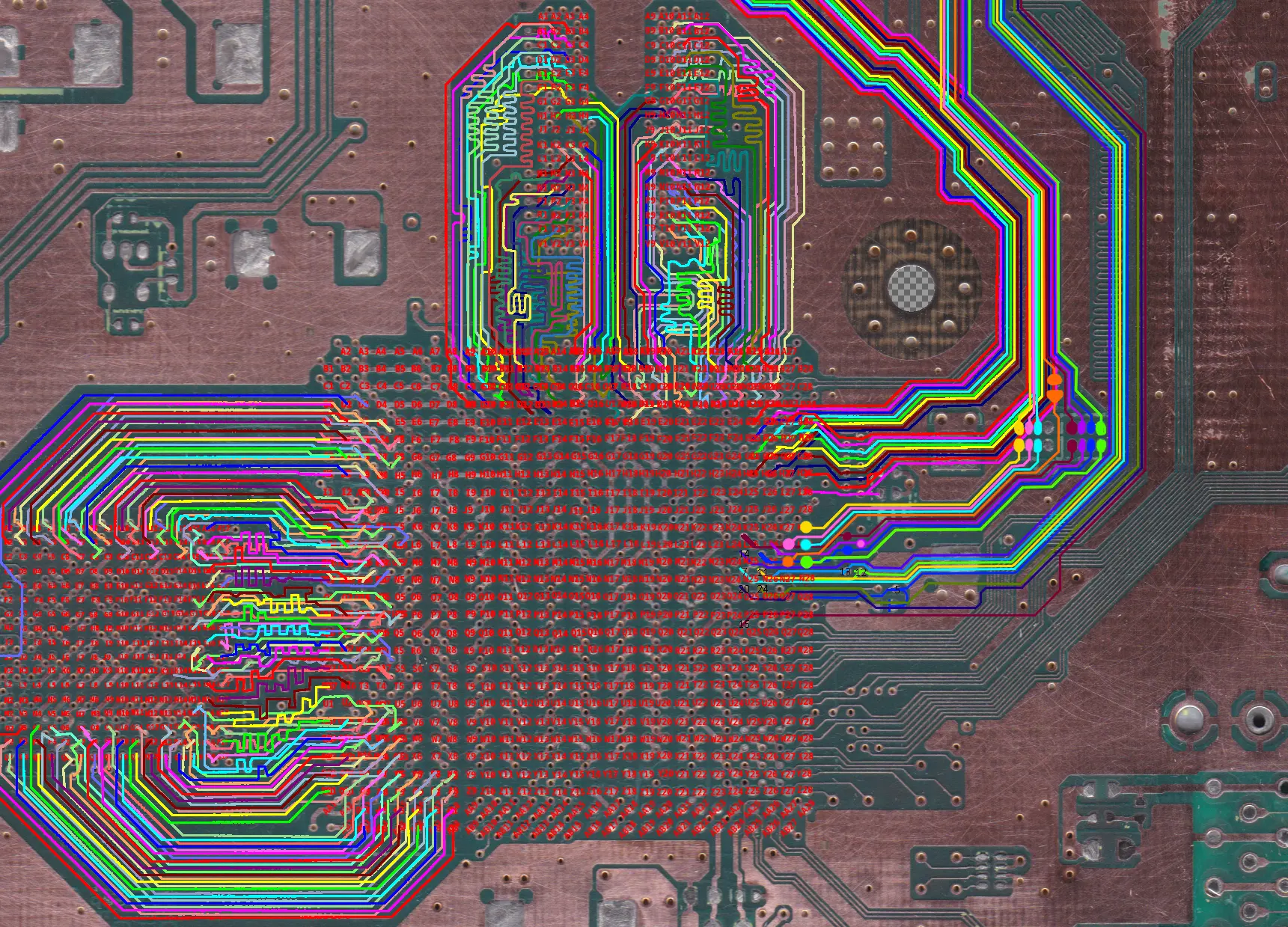
pretty_colors.webp

mx.webp

nand.webp

gddr3.webp
 
Many have walked the path you set yourself onto, none have succeeded except a professional shop who did a batch of new mobos
It would be something to see it happen for real! Best of luck
 
Thank you! This is a big undertaking, and I really hope I have the discipline to *at least* get a board made and some stuff soldered to it. My goal is to get something booting within the next 6 or 7 months in time for Open Sauce, my local engineering convention.

I had a feeling I wasn't the first to try this, but I couldn't find any info on previous attempts at a PCB reverse engineer. If you know any, could you link them? Maybe they learned some important lessons that will save me some headache.
 
I sure can:
I recommend spending some time reading the worklogs on the forums—they contain a wealth of information that will be extremely helpful.
You should also consider joining the Discord server. It’s very active and packed with useful resources, even if many of them are unfortunately buried behind Discord’s limited search functionality.
Yveltal maintains an excellent portablizing repository. It may or may not be directly applicable to your use case, but it provides a comprehensive list of open-source modules commonly used for building portables and is well worth exploring.
 
So far the biggest hurdle with making an AIO transplant board has been reflowing the Hollywood and Broadway chips. For some reason the dies just seem to self destruct most of the time. Even cutting and sanding the Wii PCB off of the BGA substrate so that it only needs to be heated once still results in cracked dies. I'm not sure if the cause has yet been definitively identified, but last I saw the leading theory was moisture staturation causing steam bubbles. I wonder if maybe using a low temp oven or vacuum chamber to dry out the chips might improve viability.

There was one guy who claimed to have populated an entire batch of functional AIO boards, so assuming he was telling the truth there must be some trick to it unless he just brute forced through the losses. I have to wonder whether there's some possibility of making a custom land grid array socket for the Hollywood and Broadway to remove the heat cycle as a point of failure.

You'll also have to match trace impedence nigh exactly, or the high speed buses will shit the bed and refuse boot even if the dies survive.

Good luck!
 
So far the biggest hurdle with making an AIO transplant board has been reflowing the Hollywood and Broadway chips. For some reason the dies just seem to self destruct most of the time. Even cutting and sanding the Wii PCB off of the BGA substrate so that it only needs to be heated once still results in cracked dies. I'm not sure if the cause has yet been definitively identified, but last I saw the leading theory was moisture staturation causing steam bubbles. I wonder if maybe using a low temp oven or vacuum chamber to dry out the chips might improve viability.

There was one guy who claimed to have populated an entire batch of functional AIO boards, so assuming he was telling the truth there must be some trick to it unless he just brute forced through the losses. I have to wonder whether there's some possibility of making a custom land grid array socket for the Hollywood and Broadway to remove the heat cycle as a point of failure.

You'll also have to match trace impedence nigh exactly, or the high speed buses will shit the bed and refuse boot even if the dies survive.

Good luck!

That "one guy" was confirmed to be Funnyplaying and was a test batch to dial in a process and see if custom motherboards were viable commercially. Yveltal was able to confirm all this a while ago.

Anyway, to further add onto this, it seems like the 4 layer Hollywood is the most fickle in this regard. Drew has had success swapping Hollywood-2s (RVO-10 4 layer (theoretically), some Wii Minis) around on OEM boards with minimal issue. Not sure if the 6 layer chipset has been tried, but that's not an ideal target for many reasons.
 
Man that must be insanely frustrating, spending months (years?) reverse engineering a board and then realizing THAT was the easy part. I am lucky enough to have access to some decent rework equipment at a local hackerspace, so I won't be doing this all with a hot air gun from Menards. I'll keep working on this in my spare time and mentally preparing myself for the difficult rework job ahead.

I was concerned about the impedance of the high speed traces on the GDDR3. When the time comes for layout, I was going to do what others have and basically just copy the traces verbatim from the original scans. I'm a bit worried that this may be considered copyright infringement, but for an experiment like this I don't really care.

I'm not the biggest fan of discord but I will join the BitBuilt one. Thank you everyone for providing fantastic info I was unable to find.

Like most of my projects, I'm just going to open source this immediately. I assume posting a link here will get my post flagged for manual review, if we're not allowed to post links like this I will remove it.

 
Man that must be insanely frustrating, spending months (years?) reverse engineering a board and then realizing THAT was the easy part. I am lucky enough to have access to some decent rework equipment at a local hackerspace, so I won't be doing this all with a hot air gun from Menards. I'll keep working on this in my spare time and mentally preparing myself for the difficult rework job ahead.

I was concerned about the impedance of the high speed traces on the GDDR3. When the time comes for layout, I was going to do what others have and basically just copy the traces verbatim from the original scans. I'm a bit worried that this may be considered copyright infringement, but for an experiment like this I don't really care.

I'm not the biggest fan of discord but I will join the BitBuilt one. Thank you everyone for providing fantastic info I was unable to find.

Like most of my projects, I'm just going to open source this immediately. I assume posting a link here will get my post flagged for manual review, if we're not allowed to post links like this I will remove it.


I wouldn't worry about copying track layout verbatim in this case. For one it wouldn't be copyright, it would fall under patent law, and I believe all Wii related patents either are already expired or will be expiring very soon, so you should be good regardless. Nintendo historically doesn't really go after this kind of thing anyway. Most, if not all current motherboard recreation attempts do copy a lot or all of the PCIe & DDR bus routing verbatim.
 
Especially seeing as you can't just make a Wii out of of the shelf parts and flash a stolen firmware on it. You have to buy a Wii and transplant the parts, which is a legal and protected act under USA and Australian law. Might even be in EU law too, not sure.
 
Back
Top