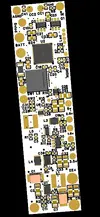
Hi guys, while working on my project lately I developed two options, one "custom" and the other "complete" for portable applications. It has currently been developed and tested on the PlayStation 2, but obviously if it reflects the settings for other consoles it can also be used for them. At the moment the Wii should be cut out since it only has one power stage for the CPU/GPU, but I could think about remodeling it and adding an additional stage, perhaps for my XII Boy, since the PMS v1 has the 3.3V problem.
Bestiolino "Nano":
What is it and how does it work?
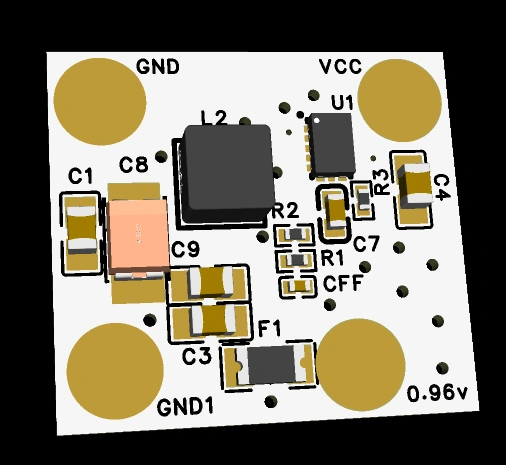
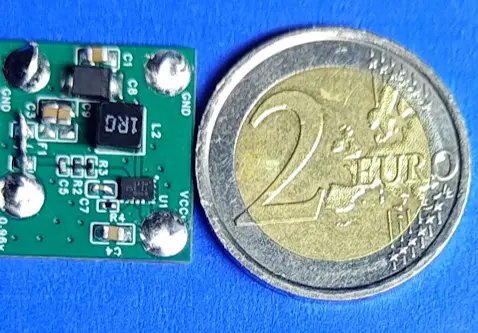
"Nano" is, like the word, a highly small and efficient micro regulation module. It uses a step-down model: TPS62816 from Texas Instruments. It is designed to be a "modular" module and to be "patched" directly onto the console's motherboard in order to apply the power directly without disturbances or voltage drops. It is easily modifiable and these are the technical specifications:
AEC-Q100 qualified for automotive applications – Device temperature –40°C to +125°C
Input voltage range: 2.7 V to 6 V --> therefore it is essential to use it with a 1S configuration (li ion - Lipo - LiHv etc.)
Output voltage from 0.6 V to 5.5 V
Maximum current delivered 6A
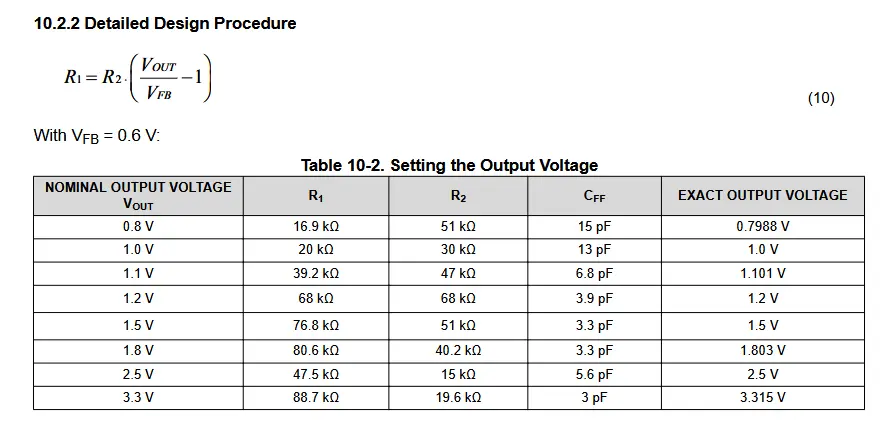
The output is quite simple to set just change the value of R1 - R2 - CFF , here is an example table:
Obviously, being a step down and if powered directly from the battery, I do NOT recommend output voltages below 2.5v.
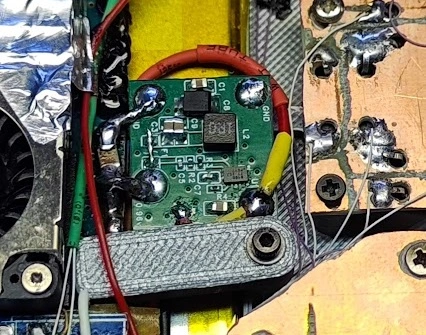
Here it is in action on PS2:
Making a quick comparison with the tlv62095 testing outrun 2006 in demo mode I got 3h and 5min, with "Bestiolino" I went up to 3h and 27min only by replacing this regulator, about 12% more efficient.
Link for this first release: GitHub
A quick tip:
The PCB has an F1 output for testing (I added a 3A self-resetting one), but it's best to remove it if it's working properly.
The inductor I chose was a 1uH inductor, but if you have height issues, you can use a 0.22uH like: AWLU0420F-R22MPA after a few quick tests, it seems to work properly.
Bestiolino "Full": currently in development / debugging ready for release
"Full" beast as the word suggests represents a real all-in-one PMS, let's study it more closely:
TPS62816 --> the heart of the "Nano" 6A maximum for cpu/gpu core
TPS628438 --> the replacement for the ldo there are 3 solderable models but all with the same package / pinout variable voltage from 0.4v up to 3.6v easily via a single resistor - in this setup 1.8V - 600mA Max
TPS628501 --> There are also various variables available (see datasheet) in this setup it will be used for 2.5v - 1A Max
TPS63802 --> Here is the "champion" IC , already extensively covered on my 79001, a hybrid converter capable of changing its internal operation to constantly deliver 3.5v 2A Max
TPS61022 --> "small" step up 5V - 8A available
Sw6106 --> last but not least, the heart of it all is a power bank IC that in addition to "giving us" a second 5V rail so as to separate for example PS2 / audio / LCD as we prefer, manages the cell charging and much more, currently it will be limited to 5V 2.5A input charging but can handle over 18W with fastcharge (to be tested), it is also easily customizable thanks to a single resistor to program the type of battery to use
Some comparison photos between "nano" and u-amp:
New Version 2.0 , completely redesigned:
TPS62816 --> the heart of the "Nano" 6A maximum for cpu/gpu core
Rt9193 --> I’ve taken a step back from my previous approach—not because of the LDO issue often discussed regarding the PS2, but mainly due to the soldering difficulty caused by its tiny size, and because I wanted to propose a project that is feasible for everyone. Furthermore, since both 1.5V and 1.8V versions are available, it can easily be swapped out if any instability arises.You just need to twist the cables supplying power to the PS2.
TPS628501 --> There are also various variables available (see datasheet) in this setup it will be used for 2.5v - 1A Max
TPS63802 --> Here is the "champion" IC , already extensively covered on my 79001, a hybrid converter capable of changing its internal operation to constantly deliver 3.5v 2A Max
TPS61023DRLR--> 5V - 3A available - The other one had MOSFETs that were too large and didn't handle the op-amp's variable load well at maximum volume—plus, the output filtering was reinforced.
Sw6106 --> last but not least, the heart of it all is a power bank IC that in addition to "giving us" a second 5V rail so as to separate for example PS2 / audio / LCD as we prefer, manages the cell charging and much more. I added the CC1 and CC2 lines, so it can easily support fast charging from 5V up to 12V, delivering up to 15W.
Let's look at the pros and cons: Pro:
Extremely small and versatile (slightly smaller than the v1)
Very efficient in terms of both energy and heat (it practically only emits heat while charging the battery).
It doesn't have the 3.3V-3.5V issue—which, from what I gather, affects not only the PMS1 but also the PMS2—so it utilizes 99% of the battery.
No ICs to program or anything else; a simple resistor (or lack thereof) can set the output battery voltage (from 4.2V to 4.4V).
all the appropriate protections (however, it is recommended to use the dedicated protection circuit for the battery output)
On-board NTC for additional protection, plus all the various monitoring and management LEDs.
I chose the SW6106—despite it being an older IC that doesn't use modern technologies—because it lacks a charge level indicator (fuel gauge). What does this mean in simple terms? Basically, you can disconnect and reconnect your battery with peace of mind without destabilizing the system's charge percentage reading. You connect the battery, the IC reads the voltage and assigns a percentage—easy, fast, and immediate. With ICs that have a fuel gauge, you are forced to drain the battery to 0% and recharge it; otherwise, the reading will be incorrect, leading to major issues (though this depends on the specific chip).
All the ICs belong to the same family and have easily configurable output voltages (excluding the LDO and SW, of course).
Cons:
Given its compact size, I realize that even though the components are "easy" to solder, a novice might face significant difficulties, as many of them are stacked on top of one another.
I have run several tests so far (I haven't thoroughly analyzed the original circuit), and it appears that charging is limited to 15 W (at least at 9 V; the figure drops at 5 V) compared to the SW6106 reference PCB.
It lacks a touch button for activation; I list this as a downside, though my goal was to have zero standby power consumption.
Operation is slightly "unusual" – see below.
It has currently been tested on the 90004 console, though not long enough to say with 100% certainty that it is problem-free; I mention this merely as a precaution because I like to be transparent, but I don't foresee any major issues that would prevent its use.
The voltages are standard, except that:
EE Power is set to 0.975v . So it's best to use thick cables that are as short as possible; it works fine on my 79001 and on this 90004 I'm testing.
The RAM voltage is set to 1.5V, but if issues arise, simply replace the IC with the 1.8V model; it draws input power from the 2.5V rail to optimize power consumption.
The remaining rails are identical to the originals and meet standard specifications.
Operating principle:
The switch (SW1 and SW2) is triggered via a resistor connected between its "key" pin and ground to "wake it up"; this way, as soon as the circuit closes, it immediately begins supplying power (in this case, the "5vlcd" line). This line serves both as a secondary power source and as an enable signal for downstream regulators; consequently, using it is strictly mandatory—otherwise, without a load, the switch will cut off the voltage, rendering the circuit inactive (though a bypass comes later, lol).
When charging the console while it is powered on, the (5V LCD) output drops for about 500ms; the D1, R1, and C3 circuit handles this to prevent the main regulators from shutting down. Should you encounter issues here, simply increasing the capacitance of C3 would solve it, though I do not believe that will be necessary, as I have conducted sufficient testing.
Therefore, the 5VLCD rail should not be used to power critical components—such as USB devices or others—that would cause the system to crash in the event of a momentary power interruption.
For the LCD and Amp, you can even connect to the PS2's 5V line—just avoid USB or anything else that might cause the game to freeze.
As above, but if the device is charging in fast-charge mode, how can it output 5V? Fortunately, it immediately switches the input to 5V regardless of the source voltage, so there are no issues with the output rail (5VLcd).
The battery's positive terminal is permanently connected to the regulators' positive terminals, so keep this detail in mind. Another point to note is that the circuit features two separate GND connections. Based on the operating principle described above, the system will function once connected. Since this is a power connection, ensure you use cables and a switch capable of handling the required current.
The BOM includes a 30k resistor for 4.4V; if you use a standard 4.2V battery, for example, R7 should not be installed—leave the circuit open.
For the initial startup, I recommend beginning with the regulator section as follows: populate from the bottom up, starting with the EE rail. Populate the entire area and apply power to the BATT input (using a bench power supply to simulate the battery; ideally, set a low current limit on the supply to prevent damage in case of issues). If everything looks correct, proceed by jumpering the BATT positive terminal to the DEBUG "EN" (enable) pin; this is the output pin following the SW6106 diode (as explained in the schematic above)—it is merely a debug pin and will not be used once the circuit is complete. If you measure 0.975V and a current draw of just a few milliamps, everything is fine, and you can proceed to the second rail, and so on (remember that the RAM rail—1.8V or 1.5V, depending on your chosen regulator—is cascaded from the 2.5V rail, so start with the latter).
Hi guys, some small updates on the trimmed 90004, with dualshock, 1 memory card and the mx4sio:
Idle: 4,42V x 0,993A --> 4,39W
Outrun demo menù : 4,42V x 1,043A --> 4,61W
Outrun 2006 in Game : 4,42V x 1,082A --> 4,78W
I'd say it currently looks like it's "broken" the 5W limit!
obviously all that glitters is not gold, I made some mistakes on the PCB on the 5V side, nothing serious, the main problem is on the SW6106 side, it seems like a small disaster, I will have to understand better how to "fix" it, in the meantime I ordered another board so that I can understand pin to pin how to fix it
Its nice because we know that the ps2 can run off of more standard voltages by combining the 1.75v and 2.5v rails and running it at 1.8v, and running everything else respectively at 1v and 3v3 instead of 1.25v and 3.5v (which only gives tiny gains but its gains none the less), so I'd almost like to try my hand at making a different iteration of the PMS to support undervolting with an EE app for adjustments similar to what we have with thundervolt!
Hi guys, let's say the table should be more or less like this:
1,25v --> max 0.95v The little "bestiolino" is set to around 0.975v which drops by 0.15v-0.20v under load. Both this and my 79001 work without problems.
1.75v --> max 1.5v (I'm testing it)
2.5v --> as said by legend at 1.8v NB: my 79001 wouldn't boot at all and this 90004 model shows flickering lines on the AV output (I haven't tried the VGA) so I'd say the video encoder doesn't like it
3.5v --> 3-3.3v? at 2.5v the ps2 won't boot, probably the mechacon remains in a permanent reset state
5v -->The console boots and runs at 3.3v but the image has very "clipped" colors and shades
so technically by eliminating the video encoder and applying a RVL-DD (I think this is exactly the work Mister X is doing) you can apply as above
Returning to the project, I fiddled with the SW6106 and managed to get the 5V output, I also connected the charging status/diagnostic LEDs and they are ok. I was using MOSFETs that were not digested by the IC, currently they are temporary but I manage to get stable above 5V and the LCD on so I'd say at least for now it's ok.
but currently it seems that I can't recognize the 5v input to charge the batteries, an error that I had "discovered" I forgot to connect a vout line of the USB C socket (which in this configuration is precisely our input and not "hybrid") the other one discovered yesterday and that to simulate the cc1 and cc2 I inserted 51k resistors and not 5.1k. but even with these precautions it completely disgusted me lol , but I'll figure it out somehow.
taking away the last tidbits I'm just "undecided" about these two ic:
-TPS628438
-TPS61022
The TPS628438 is truly microscopic, it's as big as a 603 resistor but it has 6 pins, so I realize that it's not exactly easy to solder, so in the meantime, since the console seemed to boot at 1.5V as written, I would like to try directly with an LDO. Eventually, the loss of using an LDO coupled with the undervolt could bring us to the same level of using this IC but with fewer components and soldering complications.
The TPS61022 is not convincing me, it seems too fragile, it goes into internal short circuit as soon as you make a "false step" while the other ICs respond very well, another example just by removing it you gain another 30ma vs sw6106, so another option to be able to align the board is to use a second TPS63802 like on my 79001 which works very well without too many "stories"
I forgot that for the cc1 and cc2 lines you need a resistor of 5 or 10k but towards vbus (so 5v) and not towards ground otherwise the integrated "sleeps" also confirmed that you need mosfets with vgs 0.9v like the ones unsoldered from the original module that I currently purchased, even with those collected from old motherboards it works and supplies 5v, the battery recharges both at 5v and 9v input, between 7 and 12w (to be verified better with the new mosfets) so it is optically finished.
TPS628438 --> for him I did a flying test to understand if as written it could be abolished by simplifying the circuit the answer is yes and the RAM can be stably brought to 1.5v without problems I used an ams1117 waiting for the rt9193. in the end this undervolt saves about 25ma on the line but increases it by 6ma on the battery I would say that it is a current that can be safely negligible, moreover therefore anyone who has problems can simply change the rt9193 from the 1.5v variant to 1.8v without modifying anything to the circuit simply by changing the IC.
TPS61022 --> TPS61023 for him it seems to have found a feasible replacement we will not have that very high ceiling of 8A (which was also useless) but it should also be more efficient for the current range that we need around 1-1.5A (assuming ps2 - usb and possibly as I did a linux board for SMB) ,It has almost the pinout of the old IC so I can adapt it to the tracks and try it on this board already , same components inductor etc, great.
I also did tests with 3.5v, as I suspected the limit is 3.1v but there is a risk that the console will freeze like 1.8v if it goes too low, in the end we are talking about very few mA saved which honestly is not worth "shaving off" to maybe find a paperweight during the games.
1,25v --> max 0.95v - 0.93v (unnecessary risk of consumption not relevant to doing this stay between 1v and 0.95v)
1.75v --> max 1.3v (unnecessary risk of consumption not relevant to doing this)
2.5v --> with the original video encoder it is better to leave it stable
3.5v --> 3.1v (unnecessary risk of consumption not relevant to doing this)
5v --> 5v same like 2.5v
Another modification will be to optimize the board so that the outputs are parallel to the motherboard so that we can have the shortest cables possible
some photos of the two rails tested 1.8v and 3.5v of how much they can go down and how much they consume, the other two total consumption console + lcd test with TPS628438 (lower consumption) and without with ams1117 at 1.5v for 1.8v (consumption 6ma higher)
It will take a while to get the new components and do further testing but at the moment I feel quite "calm"
Once it goes into production the V2 should be pretty much ok (hopefully)
added pins cc1 and 2 to test fast charging (the original module from aliexpress gets very hot at 20w), in that case solder a small resistor and block the module from accepting 5v 2.5a.
added the 4th pin for the LEDs "just for the sake of it"
The TPS for the 1.8V has been removed and replaced with the RT9193. Anyone who wants can use its 1.5V variant by just changing the IC. If everything works with this voltage, there will even be an improvement in battery life, even though the gap between the 2.5V and the LDO is greater, but as shown in the screenshots above, it will have to work much less since the absorption will be reduced.
I haven't tried the TPS61023 but I'm confident
enlarged the pads for a bigger inductor for the sw (fast charging evaluation) more optimized track routing and dimensions (v1 bottleneck probably)
redesigned the entire PCB to be in line with the PS2 pads, so as to have the shortest possible cables, it can be mounted either flat or on its side in case of placing a heatsink on the rear side
I changed the MOSFETs, both the ones I had planned and the original ones (two in parallel in the same package)
something else that I probably don't remember in my mind, as soon as everything arrives I'll be able to do some more tests to evaluate if it's possible to release it as the final version
there would be another one but it is "farsighted" enough to be able to predict how it will work
Hey guys, the v2 has finally arrived! "Surprisingly," everything worked on the first try without any issues! I still need to test it under load, but right now the PS2 boots up and charges the battery at 3A (fast charge).
Ps2 + U-amp --> 4.4v x 1.005A --> 4,42 W